
“What exactly does my child learn in kindergarten?”
It’s the question every parent asks – and deserves a clear, honest answer.
For many parents, kindergarten feels like a mystery box. You drop your child off, they come home happy and tired, and somewhere in between, “learning” is supposed to have happened. But what does that actually look like? What concepts are being developed? And how do you know if your child is truly progressing?
At Kidzee Channarayapatna, we believe parents deserve to be fully informed partners in their child’s education. Transparency is one of our core values. So in this article, we’re pulling back the curtain completely – walking you through every major kindergarten learning concept your child explores at Kidzee CRPatna, why each one matters, and how our teachers bring it to life every single day.
Whether you’re searching for a kindergarten in Channarayapatna, evaluating preschools near me, or simply curious about what modern early childhood education looks like – this guide is for you.
What “Kindergarten Learning” Really Means
The word “kindergarten” comes from the German for “children’s garden” – a place where young minds are cultivated like seeds, not force-grown.
Sadly, many parents still carry outdated memories of kindergarten: children sitting in rows, copying letters from a blackboard, being hushed when they move or speak. Modern early childhood education research has completely transformed this picture.
Today, the best kindergartens – including Kidzee Channarayapatna – understand that children aged 3.5 to 5.5 years learn best when:
- Learning is embedded in play and exploration, not rote repetition
- Concepts are taught across multiple senses – hearing, seeing, touching, moving
- Children feel emotionally safe enough to take risks and make mistakes
- Progress is measured by developmental milestones, not test scores
- Every activity is intentional – designed to build a specific skill or concept
With this philosophy as our foundation, here is a comprehensive breakdown of the kindergarten learning concepts your child will master at Kidzee CRPatna.
The 7 Core Kindergarten Learning Concept Areas at Kidzee Channarayapatna
1. 📚 Language & Early Literacy — The Foundation of All Learning
Language is the lens through which children understand everything else. Before a child can read, write, or reason, they need a rich, well-developed command of language – spoken, heard, and eventually written.
At Kidzee Channarayapatna, Language & Literacy development is woven through every part of the school day, not confined to a single lesson.
Key concepts covered:
- Listening & Comprehension – Following instructions, understanding stories, identifying main ideas
- Spoken Language Development – Expressing thoughts clearly, expanding vocabulary, asking questions
- Phonological Awareness – Recognising that words are made of sounds (phonemes), the bedrock of reading
- Phonics Introduction – Connecting letters to their sounds (A says “ah,” B says “buh”)
- Print Awareness – Understanding that text is read left to right, that words have spaces between them
- Emergent Reading – Recognising sight words, “reading” picture books, predicting story outcomes
- Pre-Writing Skills – Developing pencil grip, drawing lines, curves, and basic letter shapes
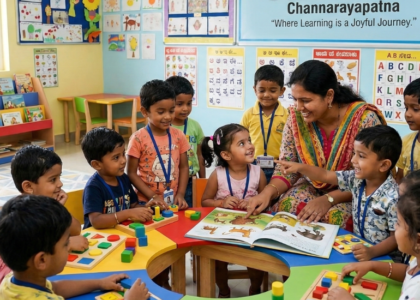
How KidZee teaches it: Story circles, puppet theatre, picture book discussions, rhyme games, alphabet treasure hunts, sand-letter tracing, and daily conversation routines that encourage every child to find and use their voice.
Why it matters: Children with strong early literacy skills are significantly more likely to become confident readers by Grade 2 – and strong readers consistently outperform peers in every academic subject throughout schooling.
2. 🔢 Early Mathematics & Number Sense — More Than Just Counting
Many parents think kindergarten maths is simply counting to 10. At Kidzee CR Patna, we go far deeper – building genuine number sense, which is a child’s intuitive understanding of how numbers work and relate to each other.
Key concepts covered:
- Counting & Cardinality – Understanding that the last number counted equals the total quantity
- Number Recognition – Identifying numerals 1–20 (and beyond for advanced learners)
- One-to-One Correspondence – Matching one object to one number (foundational for all arithmetic)
- Comparing & Ordering – More/fewer, bigger/smaller, first/second/last
- Basic Addition & Subtraction – Through physical objects, not abstract symbols
- Shapes & Geometry – Identifying and describing 2D and 3D shapes in the real world
- Measurement & Comparison – Tall/short, heavy/light, long/short using non-standard units
- Patterns & Sequencing – Recognising and creating repeating patterns (ABAB, ABCABC)
- Sorting & Classifying – Grouping objects by colour, shape, size, or function
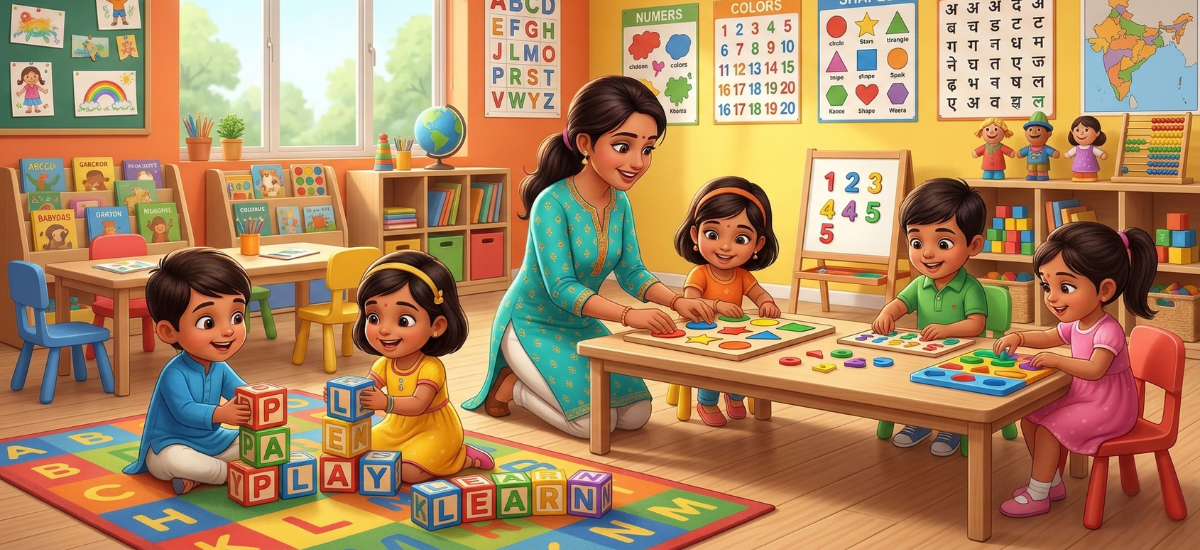
How Kidzee teaches it: Counting games with colourful manipulatives, number hopscotch, pattern-making with beads and blocks, shape hunts around the classroom, cooking activities that introduce measurement, and daily calendar routines that make numbers meaningful.
Why it matters: Early number sense is one of the strongest predictors of long-term mathematical ability. Children who develop solid maths foundations in kindergarten consistently perform better in STEM subjects throughout their academic journey.
3. 🌍 Environmental Awareness & Early Science — Curious Minds, Bright Futures
Young children are natural scientists. They touch everything, question everything, and experiment constantly. At Kidzee Channarayapatna, we channel this instinct into structured early science and environmental learning that builds a lifelong love of discovery.
Key concepts covered:
- Living vs. Non-Living Things – Identifying what is alive, what grows, and what doesn’t
- Plants & Animals – Basic life cycles, habitats, and the needs of living things
- Weather & Seasons – Observing and describing weather changes; understanding the four seasons
- The Five Senses – Using sight, hearing, touch, smell, and taste to explore the world
- Cause & Effect – “What happens if I mix these colours?” – developing the scientific mind
- Simple Materials & Properties – Hard/soft, rough/smooth, sink/float experiments
- Environmental Responsibility – Early values of caring for the earth – recycling, watering plants, not wasting
How Kidzee teaches it: Nature walks in the school garden, simple classroom experiments (growing seeds, making volcanoes with baking soda), sensory exploration bins, weather charts, and “Scientist of the Day” activities that put children in the lead role.
Why it matters: Science is not a subject – it is a way of thinking. Children who learn to observe, question, and test ideas in preschool carry this intellectual curiosity into every area of their lives.
4. 🎨 Creative Arts & Aesthetic Development — Intelligence Has Many Forms
Dr. Howard Gardner’s theory of Multiple Intelligences tells us that not all children are smart in the same way. Some children are visual-spatial learners. Others are musical, bodily-kinesthetic, or interpersonal. At Kidzee CR Patna, our Creative Arts programme honours every form of intelligence.
Key concepts covered:
- Visual Art – Colour theory (primary/secondary colours), line, shape, texture, composition
- Music & Rhythm – Beat, tempo, pitch, dynamics, and musical storytelling
- Drama & Storytelling – Character, plot, dialogue, emotion, and performance
- Dance & Movement – Body awareness, spatial expression, rhythm interpretation
- Creative Thinking – Open-ended making where there is no single “right” answer
- Aesthetic Appreciation – Developing the ability to notice and respond to beauty in the world
How Kidzee teaches it: Free art exploration alongside guided projects, music circles with percussion instruments, drama performances for parents, creative movement sessions, and an annual Art Exhibition showcasing every child’s work.
Why it matters: Creative arts build the divergent thinking skills that are the foundation of innovation. In a world increasingly driven by creativity and adaptability, the child who can think originally has a profound advantage.
5. 🤝 Social & Emotional Learning (SEL) — The Most Underrated Kindergarten Subject
If you could only choose one area of kindergarten education to prioritise, research suggests it should be Social and Emotional Learning. Children with strong SEL foundations have better academic outcomes, healthier relationships, and greater mental wellbeing throughout their lives.
At Kidzee Channarayapatna, SEL is not an add-on – it is woven into every single interaction of the school day.
Key concepts covered:
- Self-Awareness – Identifying and naming their own emotions (“I feel excited / scared / proud”)
- Self-Regulation – Managing big feelings without losing control (calming strategies, deep breathing)
- Empathy – Understanding how others feel; responding with care and kindness
- Social Skills – Sharing, taking turns, asking to join play, saying sorry genuinely
- Conflict Resolution – Using words to solve problems; understanding that disagreements are normal
- Resilience – Trying again after failing; understanding that mistakes are how we learn
- Independence – Making choices, managing belongings, completing tasks without constant adult help
- Respect & Inclusion – Valuing differences in others; understanding that everyone belongs
How Kidzee teaches it: Morning check-ins where children name their feelings, circle time discussions about fairness and kindness, role play scenarios, Peace Corner (a calm-down space), teacher-modelled emotional language, and stories with strong SEL themes.
Why it matters: A child who can manage their emotions, communicate their needs, and understand others’ perspectives is ready to thrive – academically, socially, and professionally – for life.
6. 🏃 Physical Development — Strong Bodies, Strong Minds
There is a direct, well-documented connection between physical movement and cognitive development in young children. At Kidzee CRPatna, physical development is taken as seriously as any academic subject.
Key concepts covered:
Gross Motor Skills (Large Movements):
- Running, jumping, hopping, skipping, galloping
- Climbing, balancing, throwing, and catching
- Yoga poses and structured movement sequences
- Following multi-step physical instructions
Fine Motor Skills (Small, Precise Movements):
- Pencil and crayon grip and control
- Cutting with child-safe scissors
- Threading beads, using tweezers, folding paper
- Buttoning, zipping, and managing personal belongings
Health & Body Awareness:
- Basic hygiene habits (handwashing, dental care)
- Understanding hunger, thirst, rest, and physical needs
- Nutrition basics – fruits, vegetables, healthy choices
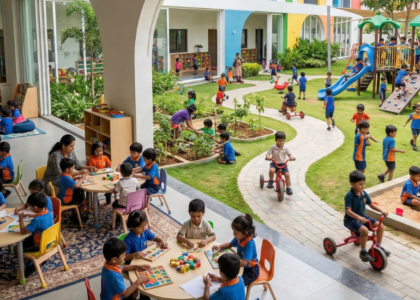
How Kidzee teaches it: Outdoor play sessions, obstacle courses, yoga and stretching routines, fine motor activity stations, and daily physical activity integrated into classroom transitions.
Why it matters: Children who are physically confident are more willing to take intellectual risks. Movement also directly stimulates brain areas responsible for attention, memory, and mood regulation.
7. 💻 21st Century Readiness — Preparing Children for a World We Can’t Yet Imagine
The children in kindergarten today will enter the workforce in the 2040s. Many of the jobs they’ll hold don’t yet exist. At Kidzee Channarayapatna, we future-proof children by developing the 21st century competencies that will matter regardless of what the world looks like.
Key concepts covered:
- Critical Thinking – Asking good questions; evaluating options; not accepting the first answer
- Communication – Expressing ideas clearly in words, pictures, movement, and storytelling
- Collaboration – Working with others toward a shared goal; valuing each person’s contribution
- Creativity – Generating original ideas; making something new from what you know
- Curiosity – Cultivating the desire to keep learning, asking, and discovering
- Digital Awareness – Age-appropriate introduction to technology as a tool, not a toy
How Kidzee teaches it: Group projects, design challenges, open-ended play, show-and-tell presentations, and Kidzee’s structured exploration activities that put children in the role of problem-solver and creator.
Why it matters: The World Economic Forum consistently identifies creativity, critical thinking, and collaboration as the top skills employers will seek in future decades. These skills begin to form in kindergarten – or they don’t form at all.
How Kidzee Tracks Your Child’s Progress Across All 7 Concept Areas
At Kidzee Channarayapatna, we don’t leave developmental progress to guesswork. Our teachers use a structured developmental observation framework to track each child’s growth across all seven learning domains.
Parents receive:
| Report Type | Frequency | What It Covers |
|---|---|---|
| Daily Communication | Daily | Mood, eating, nap, key activities |
| Developmental Progress Report | Monthly | Milestones across all 7 learning domains |
| Parent-Teacher Meeting | Every term | In-depth discussion of strengths and areas to support |
| Portfolio of Work | End of term | Collection of artwork, projects, and documented learning |
| Annual Graduation | Yearly | Celebrating your child’s full year of growth |
This level of transparency and partnership is one of the key reasons Kidzee Channarayapatna is rated the best preschool in Hassan district by the families we serve.
LKG vs UKG: What’s the Difference at Kidzee CR Patna?
Many parents ask how Lower Kindergarten (LKG) and Upper Kindergarten (UKG) differ in terms of learning concepts. Here’s a clear overview:
| Learning Area | LKG (Age 3.5–4.5 Yrs) | UKG (Age 4.5–5.5 Yrs) |
|---|---|---|
| Literacy | Letter recognition, phonics sounds, pre-writing | Word building, sight words, early reading |
| Numeracy | Counting 1–20, shapes, sorting | Addition/subtraction, number writing, patterns |
| Science | Senses, living/non-living, weather | Life cycles, simple experiments, environments |
| Social Skills | Sharing, turn-taking, classroom rules | Conflict resolution, teamwork, leadership |
| Creative Arts | Free exploration, basic art media | Guided projects, performance, musical concepts |
| Physical | Gross motor focus, basic fine motor | Advanced fine motor, pre-writing control, yoga |
| 21st Century | Curiosity, communication | Critical thinking, collaboration, creativity |
Both LKG and UKG at Kidzee Channarayapatna are designed to ensure your child is not just ready for primary school – they are excited for it.
Frequently Asked Questions (FAQs)
A: Research consistently points to language and literacy as the single most important domain, followed closely by social-emotional learning. A child who can communicate confidently and manage their emotions is fully equipped to learn anything else. Both are central pillars of Kidzee’s curriculum.
A: At Kidzee Channarayapatna, academic concepts are introduced through play, not pressure. Children develop number sense through games, phonics through songs, and science through experiments. Learning feels like adventure — never like a test.
A: Kidzee CR Patna is the only preschool in Channarayapatna offering the nationally developed iLLUME curriculum – a research-backed, holistic framework that covers all 7 developmental domains, tracked through monthly progress reports and structured teacher observations.
A: Absolutely. Social and emotional learning is one of Kidzee’s greatest strengths. Our teachers are specially trained to gently build confidence in quieter children through small group work, one-on-one attention, and a nurturing classroom environment where every child feels safe.
A: LKG is ideal for children aged 3.5 to 4.5 years. We recommend enrolling early to ensure your child gets the full benefit of both the LKG and UKG year before transitioning to Class 1. Contact KidZeeCRPatna.com to check current availability and admission timelines.
Your Child’s Kindergarten Journey Starts Here
If you’re looking for a kindergarten in Channarayapatna where your child will be truly seen, deeply nurtured, and comprehensively prepared for school and life – Kidzee CR Patna is where that journey begins.
Every concept in this article is taught every single day by our trained, passionate educators – wrapped in warmth, play, and genuine love for every child in our care.
📍 Location: Channarayapatna (CRPatna), Hassan District, Karnataka
🌐 Website: KidZeeCRPatna.com
📞 Call/WhatsApp: +91 9844565633 / 9380599036
🕒 School Hours: Monday to Friday | 9:00 AM to 5:30 PM
Book a FREE kindergarten tour today — and see these concepts come alive before your eyes.
Conclusion
Kindergarten is not a soft warm-up before “real learning” begins. It IS the real learning – the kind that shapes how your child thinks, feels, communicates, and relates to the world for the rest of their life.
At Kidzee Channarayapatna, every single day is a carefully crafted opportunity to build language, number sense, scientific curiosity, emotional intelligence, creativity, physical confidence, and 21st century readiness – all through the most natural vehicle a child has: joyful, purposeful play.
This is what early childhood education looks like at its very best. This is what your child deserves.
Give them Kidzee. Give them the best start.